
You open the drawer to grab a spatula.
It won’t close again. Something in the back has jammed it. A whisk, probably. Or the pizza cutter nobody remembers buying.
You shove. It shudders. You give up and leave it open an inch, the way it has been since roughly 2022.
If that sounds familiar, here’s the good news: you don’t need a new kitchen, a weekend and a car full of matching bins. You need a better order of operations.
Most kitchen organization ideas start with the shopping. We’re starting with the part that actually makes it stick: empty, edit, group, then contain. One afternoon. Before the holiday cooking starts and the kitchen becomes the busiest room in the house.
Kitchen organization ideas start here: empty and edit
Pick one zone. One drawer, one shelf, one cupboard. Not the whole kitchen.
Take everything out. Yes, everything. You can’t see what you have while it’s still stacked on top of itself.
Wipe the empty space down while you’re there. Then sort what came out into four piles:
- Use it weekly. Goes back in, front and centre.
- Use it a few times a year. The roasting pan, the cookie cutters, the gravy boat. Goes back in, but higher, lower or further back.
- Duplicates. Do you need four can openers? Keep the one that works. The rest go to donation.
- Doesn’t work, doesn’t fit, doesn’t get used. Let it go.
The editing step is the whole trick. Containers don’t create space. They just make clutter look intentional. Fewer things is what makes a drawer close.
Containers don’t create space. They just make clutter look intentional.
Muddy tip
A quick rule for the hesitant: if you’re not sure, put it in a box with today’s date on it. If you haven’t gone looking for it in a couple of months, you have your answer.
Zones: group by how you cook, not by what things are
Here’s where most kitchens go wrong. We store things by category: all the bowls together, all the gadgets together, all the baking things in one cupboard across the room.
But you don’t cook by category. You cook by task.
So organize by zones, which just means keeping the things you use together near where you use them:
- Prep zone. Near your biggest stretch of counter: knives, cutting boards, mixing bowls, measuring cups, peeler.
- Cooking zone. Beside the stove: spatulas, wooden spoons, tongs, oven mitts, oils, salt and the spices you actually reach for.
- Cleaning zone. Around the sink: dish soap, cloths, scrub brush. Keep food and food containers away from cleaning products; the U.S. Food and Drug Administration specifically advises storing non-perishable foods away from household chemicals.
- Serving and storage zone. Near the table or dishwasher: plates, glasses, cutlery, plus food storage containers and wraps for leftovers.
- Coffee or breakfast zone (optional, life-changing). Mugs, coffee, tea, the toaster. One spot, so the morning doesn’t involve crossing the room four times.
Small kitchen? No pantry? Zones matter even more. Think vertically: a shelf riser in the cupboard, hooks under an upper cabinet, a rail on the backsplash for the utensils you grab daily. And give yourself permission to store the once-a-year items somewhere else entirely, like a labelled bin in a hall closet.
Drawers: cutlery, utensils, and the junk drawer
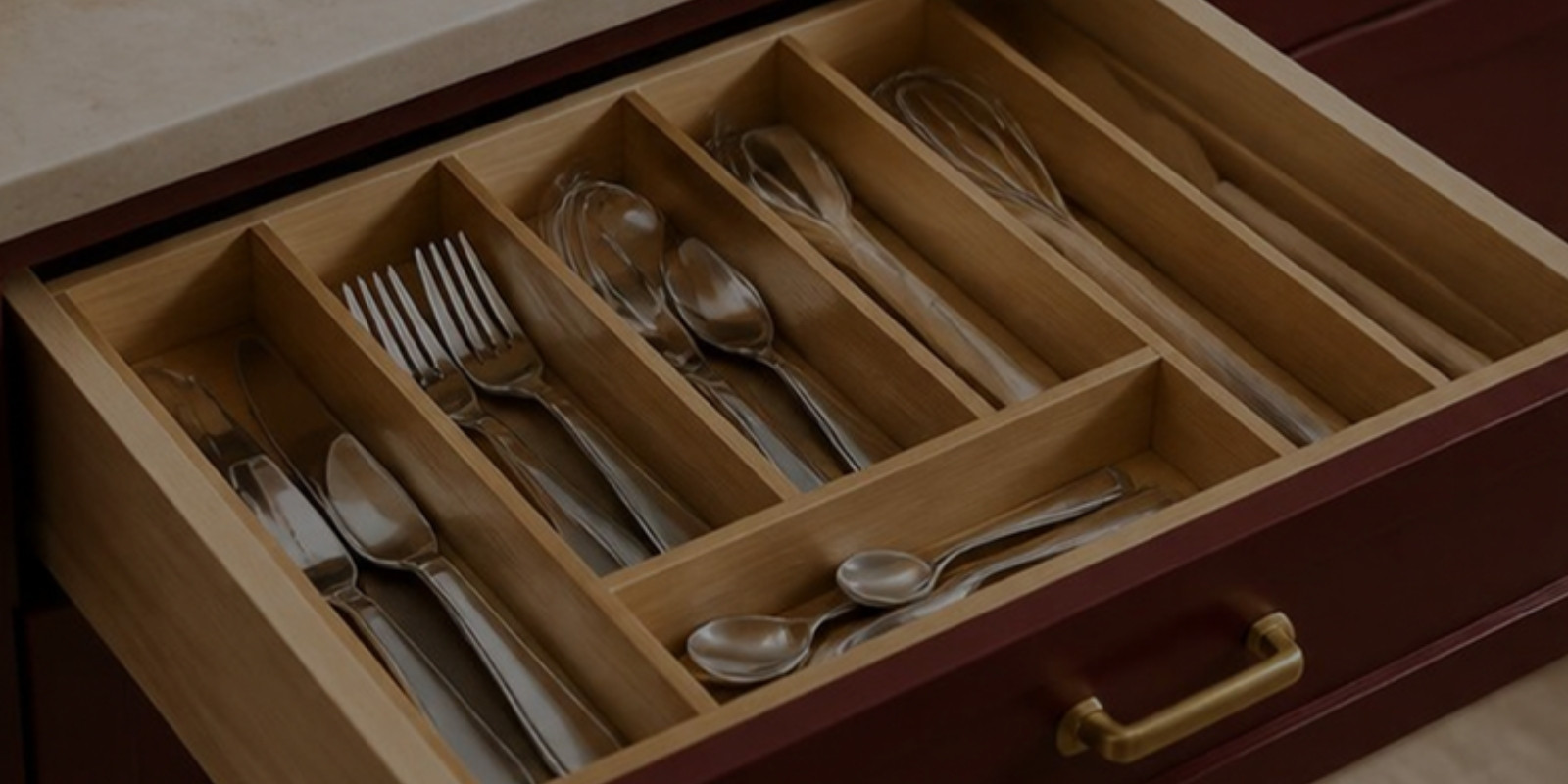
Cutlery drawer. Use a divider tray and stop there. If the tray is overflowing, that’s an editing problem, not a tray problem. Most households can lose a few stray teaspoons without noticing.
Utensil drawer. Lay things flat in a single layer, with the most-used tools at the front. Adjustable drawer dividers help long tools (tongs, ladles, the whisk that jammed everything) stop rolling into a pile. If a tool doesn’t fit lying down, it may belong in a crock by the stove instead.
Sharp things. Knives loose in a drawer are hard on the blades and harder on fingers. A knife block, a magnetic strip or an in-drawer knife holder keeps edges covered and hands safe.
The junk drawer. Keep it. Everyone needs one. Just give it boundaries: a few small trays inside it (batteries, tape and scissors, takeout menus or chargers, the mystery keys), and a once-a-season empty-out. A junk drawer with dividers isn’t junk. It’s a utility drawer with a sense of humour.
MUDDY FINDS: The Drawers
- Joseph Joseph DrawerStore Cutlery Organizer — A five-compartment cutlery tray for the one drawer you open most. Shop on Amazon
- Utoplike Bamboo Adjustable Drawer Dividers — Adjustable dividers that stop long tools rolling into a pile. Shop on Amazon
Muddy Finds may include affiliate links. As an Amazon Associate, Muddy Stilettos earns from qualifying purchases, at no extra cost to you.
Pantry: see it, use it, label it
A pantry doesn’t fail because it’s small. It fails because things disappear in the back and get bought again.
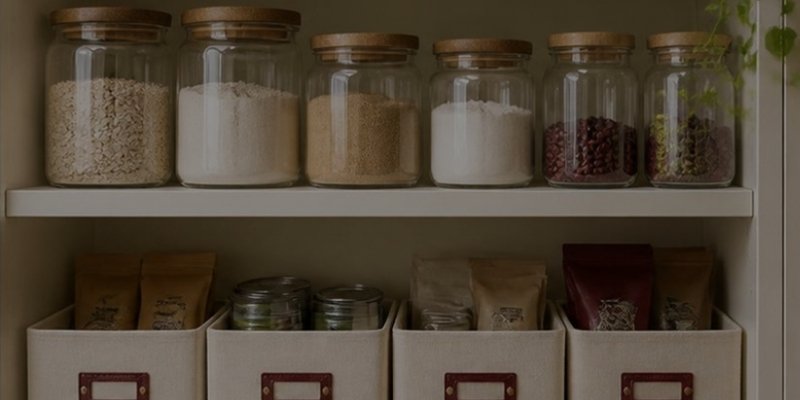
See it. Store like with like (baking, breakfast, grains and pasta, cans, snacks) and keep labels facing out. Use bins or baskets as “drawers” on deep shelves, so you pull the whole bin forward instead of reaching blind.
Use it. Older things go to the front, newer to the back. The Canadian Food Inspection Agency recommends using older items before newer ones, and buying dry goods in amounts you’ll use within a few months.
Protect it. Moving flour, rice, oats and pasta into glass, metal or thick plastic containers with resealable lids does more than look nice. The CFIA recommends sturdy containers like these to help keep pantry insects out of dry goods. (If you’ve ever found moths in the rice, you know.)
Label it. A piece of masking tape and a marker is a perfectly good label. Write what it is and, for anything you decant, the best-before date from the original package. In Canada, best-before dates are about freshness and quality of the unopened food, not safety, and once opened, shelf life can change. In the U.S., the USDA says “Best if Used By” dates are about flavour and quality, not safety.
MUDDY FINDS: The Pantry
- mDesign Deep Plastic Food Storage Bins with Handles — Pull-forward bins that turn a deep shelf into drawers. Shop on Amazon
- OXO Good Grips 10-Piece POP Container Set — Stackable, sealed containers for flour, rice and pasta. Shop on Amazon
- Rubbermaid Brilliance Glass Food Storage Containers — Glass containers with lids, so you can see what’s inside. Shop on Amazon
- Brother P-touch PT-D210 Label Maker — For when masking tape loses its charm; tape cartridges are an ongoing cost. Shop on Amazon
Muddy Finds may include affiliate links. As an Amazon Associate, Muddy Stilettos earns from qualifying purchases, at no extra cost to you.
Fridge: leftovers you’ll actually eat
The fridge is where organization becomes food safety, so let’s be precise.
Check the temperature. Health Canada says to keep your fridge at 4°C (40°F) or lower and your freezer at -18°C (0°F) or lower. The FDA recommends an inexpensive appliance thermometer in each, checked regularly, since that’s the best way to know what the temperature really is.
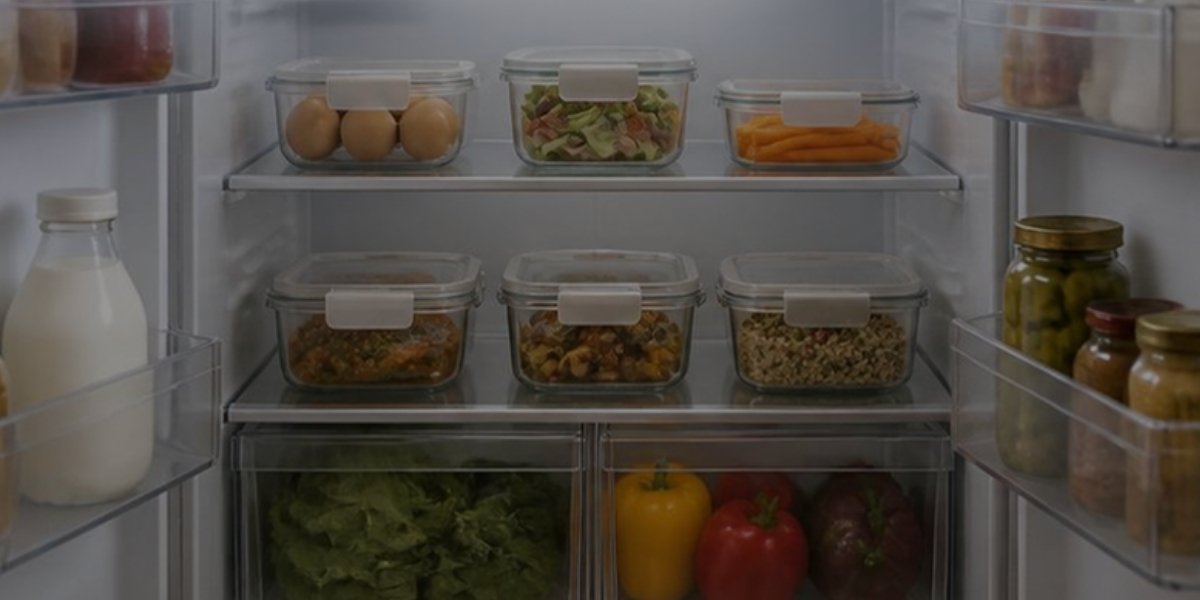
Raw meat goes low. Health Canada advises storing raw meat, poultry, fish and seafood in sealed containers or bags on the bottom shelf, so juices can’t drip onto other food. A clear bin on that shelf makes this automatic.
Don’t overpack. Both Health Canada and the FDA warn against crowding the fridge, because cold air needs room to circulate.
Make leftovers visible. Give them one shelf at eye level, in clear containers, with the date on a piece of tape. Health Canada recommends dating leftovers so you know what they are and how long they’ve been there.
Know the window. Health Canada advises eating refrigerated leftovers within two to three days, or freezing them. The USDA puts it at three to four days. We go with the shorter window, and when in doubt, throw it out: you can’t tell whether food is safe by how it smells or tastes.
Cool it quickly. Get leftovers into the fridge promptly in shallow containers so they cool fast. Health Canada says to throw away cooked food left at room temperature for more than two hours.
For the cooking part of the equation, our five low-effort weeknight formulas are in Dinner, Handled: Five Meals for the Week You Have Nothing Left.
MUDDY FINDS: The Fridge
- iDesign Linus Fridge and Freezer Bin with Handle — A clear bin for the bottom shelf. Shop on Amazon
- Stasher Reusable Silicone Food Storage Bags — Reusable bags for leftovers and snacks. Shop on Amazon
Muddy Finds may include affiliate links. As an Amazon Associate, Muddy Stilettos earns from qualifying purchases, at no extra cost to you.
Spices and cabinets: turntables and tiers
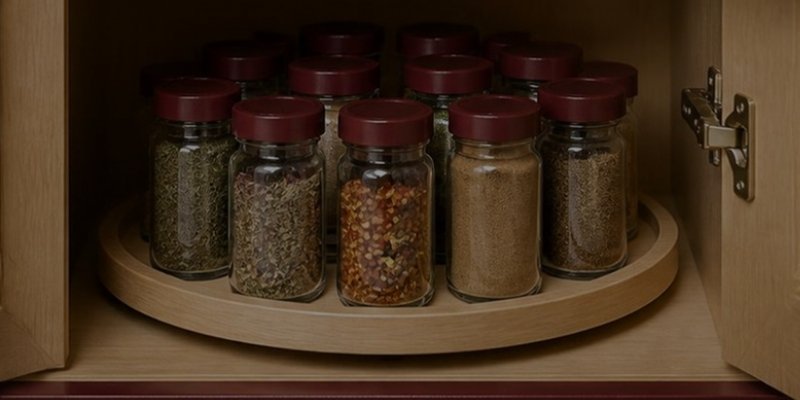
Spices are the classic “I know we have cumin somewhere” problem. Three fixes, depending on your space:
- Tiered risers in a cupboard, so the back row is visible.
- A turntable (often called a lazy Susan), which works for spices, oils and vinegars, and the deep corner cabinet nobody can reach.
- A drawer of spices lying flat, labels up, if you have a spare drawer near the stove.
Alphabetical or by cuisine? Whatever matches how your brain works. The goal is that you can see every jar without moving three others.
While you’re there, ground spices lose flavour as they age. If a jar has no smell when you open it, it isn’t adding much to dinner either.
Deep lower cabinets work the same way as deep pantry shelves: pull-out bins or baskets turn them into drawers. Pots and lids live together in the cooking zone; the roasting pan and the big platters that come out at Christmas can move to the hard-to-reach spots.
MUDDY FINDS: Spices and Cabinets
- YouCopia SpiceStack 24-Bottle Adjustable Spice Organizer — Pull-out tiers so you can see every jar. Shop on Amazon
- Copco Non-Skid Cabinet Turntable, 18-Inch — A large turntable for the deep corner nobody can reach. Shop on Amazon
Muddy Finds may include affiliate links. As an Amazon Associate, Muddy Stilettos earns from qualifying purchases, at no extra cost to you.
Keep it that way: the 10-minute Sunday reset
Organization doesn’t fail on the day you do it. It fails three weeks later.
So build in a tiny, boring habit. Once a week, before you plan meals or order groceries, set a timer for 10 minutes:
- Fridge sweep. Toss anything past its window. Move older leftovers to the front.
- Pantry glance. What’s running low? Write it on the list now, not at the store.
- Put back the strays. The scissors in the utensil drawer. The measuring cup on the windowsill.
- Wipe one shelf. Just one. Next week, a different one.
Make a coffee first (a “Pull Up a Chair” Desk Mug from our Etsy shop is very good for this) and it becomes the most pleasant 10 minutes of the week.
One more thing. If you’re the only person in your house who knows where anything goes, that’s worth noticing. Labels help the whole household put things back. And if being the family’s memory is wearing you out beyond the kitchen, How Do You Stop Carrying the Entire Family Calendar in Your Head? is for you.
Hosting this season? Our guide to easy entertaining, Hosting Without Burnout, is for you.
The Good-Life One’s take
A beautiful kitchen isn’t one where every jar matches.
It’s one where you can make dinner on a Tuesday without hunting for the colander. Where the leftovers get eaten instead of discovered. Where somebody else in the house can find the scissors and put them back.
A beautiful kitchen isn’t one where every jar matches. It’s one where you can make dinner on a Tuesday without hunting for the colander.
So skip the haul video. Start with one drawer. Empty it, edit it, put back only what earns its place, and see how it feels to close it in one push.
Then do the next one next weekend.
The holidays are coming, and your kitchen is about to work harder than it has all year. Give it a head start.
For more on food, home and the good life without the fuss, browse the Home, Food & Travel desk.
ASK MUDDY
What’s living in your junk drawer right now? Be honest.
JOIN THE MUDDY COMMUNITY
Life gets messy. We talk about it. Join the free Muddy community at muddystilettos.ca for new stories every week.
ABOUT THE MUDDY HOME, FOOD & TRAVEL DESK
The Muddy Home, Food & Travel Desk covers the food, homes, trips and small luxuries that make real life better — from Tuesday-night dinners to the weekend away you’ve been promising yourself.
Featuring The Good-Life One: finds the places, recipes, hotels and little luxuries actually worth knowing about — and understands Tuesday night, budgets and carry-on limits.
Food-safety information in this article is general and educational. Follow guidance from Health Canada, the Canadian Food Inspection Agency, the USDA, the FDA or your local public health authority.
Sources
- Safe food storage, Health Canada
- Food safety tips for leftovers, Health Canada
- How to read food date labels and packaging, Health Canada
- Live insects in packaged food, Canadian Food Inspection Agency
- Are You Storing Food Safely?, U.S. Food and Drug Administration
- Leftovers and Food Safety, USDA Food Safety and Inspection Service
- Food Product Dating, USDA Food Safety and Inspection Service
0 Comments