
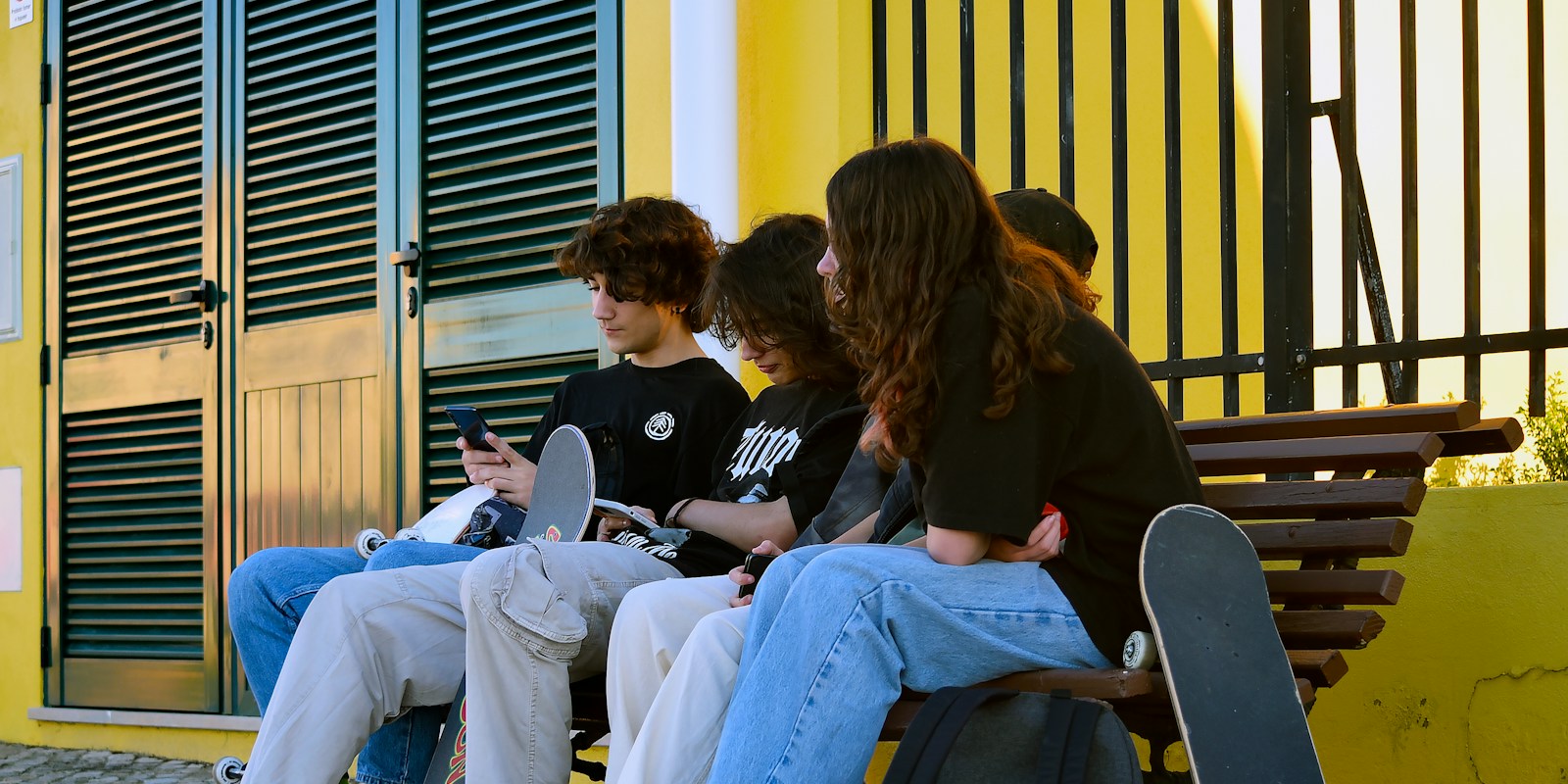
If you parent a teenager, you've probably read at least one headline suggesting their phone is slowly melting their brain.
Possibly while standing in the doorway of their room, watching them scroll.
Possibly while also holding your own phone.
The worry is real, and it isn't irrational. But if you go looking for what the research actually says, you'll find something less tidy than a headline: a genuine scientific debate, some findings most experts agree on, and a lot of practical guidance that doesn't require you to throw the phone in a lake.
Let's go through it.
First, how much are teens actually using?
A lot. That part isn't controversial.
The U.S. Surgeon General's 2023 advisory on social media and youth mental health reported that up to 95% of 13- to 17-year-olds use a social media platform, and about a third say they use social media "almost constantly." Citing survey data, the advisory reported teens spend an average of 3.5 hours a day on social media.
Teens themselves are noticing. In a Pew Research Center survey of U.S. teens conducted in fall 2023, 38% said they spend too much time on their smartphone.
The case for concern
The Surgeon General's advisory is the most-quoted document in this conversation, so it's worth knowing what it actually says.
It cites a 2019 study in JAMA Psychiatry (Riehm and colleagues) that followed a nationally representative sample of more than 6,500 U.S. adolescents. Teens who used social media more than three hours a day had a higher risk of internalizing problems — things like anxiety and depression symptoms or social withdrawal. The advisory summarizes this as roughly double the risk.
The advisory's overall conclusion is carefully worded: "We cannot conclude that social media is sufficiently safe for children and adolescents." It also acknowledges, "We have gaps in our full understanding of the mental health impacts posed by social media."
That's an important nuance. "Not proven safe" is a different claim from "proven harmful."
"Not proven safe" is a different claim from "proven harmful."
Even the lead author of that 2019 study, Kira Riehm, was clear about this, stating in the Johns Hopkins announcement: "We cannot conclude that social media causes mental health problems."
The case for "it's more complicated"
On the other side of the debate is a large body of research finding that the average link between screen time and teen well-being is small.
The most cited example is a 2019 study in Nature Human Behaviour by Oxford researchers Amy Orben and Andrew Przybylski. Analyzing data from more than 300,000 adolescents and parents in the U.K. and U.S., they found technology use was associated with, at most, 0.4% of the variation in adolescent well-being. Getting enough sleep and eating breakfast showed much stronger associations. And in a now-famous comparison, regularly eating potatoes had an association with well-being similar in size to technology use.
(Nobody is suggesting you confiscate the potatoes.)
In late 2023, the U.S. National Academies of Sciences, Engineering, and Medicine released a major report on social media and adolescent health. Its conclusion: there is not enough evidence to say that social media causes changes in adolescent health at the population level. The report noted that social media "has the potential to both harm and benefit adolescent health" — harms like unhealthy comparison and lost sleep or focus, benefits like staying connected and finding support or community, including for LGBTQ+ teens.
The big public fight: The Anxious Generation
If the debate feels louder lately, that's partly thanks to Jonathan Haidt's 2024 bestseller The Anxious Generation. Haidt argues that the shift to smartphone-based childhood in the early 2010s, combined with less independent play, is a major driver of rising anxiety and depression among young people. He's proposed solutions including phone-free schools and delaying smartphones and social media.
Developmental psychologist Candice Odgers reviewed the book in Nature and pushed back hard, arguing that most studies don't find large or consistent negative effects, that the link could partly run the other way (struggling teens may use social media more), and that there are "no simple answers." Haidt responded in an April 2024 essay on his Substack, After Babel — titled "Yes, Social Media Really Is a Cause of the Epidemic of Teenage Mental Illness" — arguing that there is evidence of causation and that the alternative explanations critics offer don't fit the facts.
So where does that leave a parent?
Honestly: the research is mixed, and you're in the middle of an unresolved scientific argument between serious people. That's uncomfortable. It's also normal for a fast-moving area of research. What it doesn't mean is "phones are fine, carry on" or "phones are poison, panic now."
Where there's much more agreement: sleep
If there's one area where the evidence is more consistent, it's sleep.
A 2016 meta-analysis in JAMA Pediatrics (Carter and colleagues) pooled 20 studies involving more than 125,000 children and teens aged 6 to 19. Bedtime access to or use of a portable media device was associated with inadequate sleep quantity, poorer sleep quality and excessive daytime sleepiness.
Teens see it too. In Pew's 2024 survey, 45% of teens said social media hurts the amount of sleep they get.
Given how strongly sleep is tied to mood, learning and health, this is one of the more practical places for families to focus — whether or not the bigger mental health debate is ever settled.
Muddy tip
If you change one thing, start with sleep: charging phones outside the bedroom overnight is one of the most commonly recommended changes, and the Canadian Paediatric Society suggests avoiding screens for at least an hour before bed.
What teens themselves say
Teens are not a monolith, and their own views are more nuanced than the stereotype.
- In Pew's 2023 survey, 72% of teens said they at least sometimes feel peaceful when they don't have their phone. But 44% said they feel anxious without it, and around four in ten said upset or lonely.
- In Pew's 2024 survey, 48% said social media has a mostly negative effect on people their age — up from 32% in 2022. Only 14% said it has a mostly negative effect on them personally.
- In the same survey, 74% said social media makes them feel more connected to what's going on in their friends' lives.
That gap between "bad for other people" and "fine for me" is very human. Most adults would probably say the same.
About us, the grown-ups
A slightly awkward data point: in Pew's 2023 survey, 47% of parents of teens said they themselves spend too much time on their phones. And 46% of teens said their parent is at least sometimes distracted by their phone when the teen is trying to talk to them.
Meanwhile, 38% of parents said they argue with their teen about phone time at least sometimes.
None of this is a reason for guilt. It is a reason to make any phone rules a family thing, not a teen-only thing.
Try this
Set screen-free times, like meals, that apply to everyone at the table — adults included.
What paediatric and psychology groups actually recommend
Here's the useful news: the major health bodies largely skip the panic and focus on how phones are used, not just how many hours.
The Canadian Paediatric Society's position statement on digital media for school-aged children and teens (published 2019, reaffirmed in 2025) is built around four ideas:
- Manage: create a family media plan with individualized limits, and revisit it regularly.
- Meaningful: prioritize face-to-face time, sleep and physical activity over screen use; favour active, social or educational uses over passive scrolling.
- Model: look at your own habits; set screen-free times, like meals.
- Monitor: watch for signs of problematic use.
The CPS recommends keeping recreational screen use out of bedrooms and avoiding screens for at least an hour before bed. Signs worth watching for include screen use that interferes with sleep, school or in-person relationships, unhappiness when technology isn't available, and defiance around limits — while noting that occasional instances can be expected.
The American Academy of Pediatrics, through its Center of Excellence on Social Media and Youth Mental Health, describes the connection between social media and mental health as "complicated and personal," and offers a free Family Media Plan tool.
The American Psychological Association's 2023 health advisory takes a similar line. Its then-president said social media "is neither inherently harmful nor beneficial to our youth." The advisory's recommendations include tailoring access to a young person's developmental stage, reducing exposure to content promoting self-harm, disordered eating or hate, limiting use that cuts into sleep and physical activity, and, for younger adolescents, supervision that respects their growing need for privacy and independence.
What about school phone bans?
In Canada, a wave of provinces moved to restrict phones in schools starting in 2024. According to the Canadian Paediatric Society's policy tracker, all ten provinces now have a province-wide policy limiting students' phone use at school, while Yukon, the Northwest Territories and Nunavut leave it to school boards or districts. Some provinces have since tightened their rules: Quebec announced in 2025 that phones would be banned for the whole school day, and New Brunswick's new rules bar personal devices for kindergarten to Grade 8 all day from September 2026, with restrictions for Grades 9 to 12 starting in February 2027. Rules vary and change, so check with your school board for the current policy. These policies are still relatively new, so it's too early to draw firm conclusions from them about effects on learning or mental health. Ask your school how its rules work in practice — and whether there's an emergency contact process that reassures you.
So what can you actually do at home?
Every teen is different, and so is every family. A teen managing anxiety, a teen whose friends live far away, and a teen who uses their phone mostly for music production may need very different approaches. With that in mind, some evidence-informed starting points:
- Start with sleep. Charging phones outside the bedroom overnight is one of the most commonly recommended changes, and it fits the sleep research above.
- Make a plan together. Teens may be more likely to buy in when they help set the rules. The CPS and AAP both point to a family media plan.
- Talk about content, not just minutes. Ask what they're seeing, who they're talking to and how certain apps make them feel.
- Talk about privacy. What they share, with whom and what apps collect. It's a conversation worth having about chatbots and AI tools too — see Before You Paste Your Life Into a Chatbot.
- Model what you're asking for. Phone-free dinners apply to the adults.
- Respect their privacy where you can. Monitoring choices depend on age and circumstances, and being transparent about any monitoring may be easier on trust than doing it secretly.
- Watch the person, not just the phone. Changes in sleep, mood, grades, friendships or withdrawal are worth a conversation — and if you're worried about your teen's mental health, talk to their doctor or a mental health professional. If you think your teen is in crisis or at risk, call or text 9-8-8 in Canada or 988 in the U.S., any time.
And if managing everyone's screens has become one more thing living rent-free in your head, you're not imagining it. We get into that in How Do You Stop Carrying the Entire Family Calendar in Your Head?
The Mom One's take
You don't need to win the scientific debate to parent well.
You don't need to win the scientific debate to parent well.
The researchers are still arguing. That's their job. Your job is the kid in front of you.
Protect their sleep. Know roughly what they're doing online. Keep talking even when the answers are one syllable. Notice if something changes. Put your own phone down sometimes, mostly so you can see their face when they finally do tell you something.
The phone isn't the whole story.
Your relationship with your teen is a much bigger chapter.
The phone isn't the whole story. Your relationship with your teen is a much bigger chapter.
For more on raising kids in the real world, visit The Muddy Family Desk.
ASK MUDDY
What's one phone rule that has actually worked in your house — and one that completely backfired?
JOIN THE MUDDY COMMUNITY
Life gets messy. We talk about it. Join the free Muddy community at muddystilettos.ca for new stories every week — honest, researched and written for real women.
ABOUT THE MUDDY FAMILY DESK
The Muddy Family Desk covers the real work of family life — parenting, partnership, caregiving and the invisible load — with honesty, humour and room for every kind of family.
Featuring The Mom One: loves her kids fiercely. Occasionally hides from them.
Muddy Family content is educational and informational and is not a substitute for individualized medical, mental health or developmental advice. If you're concerned about your child's mental health, contact a healthcare provider. In a crisis, call or text 9-8-8 — the 9-8-8 Suicide Crisis Helpline in Canada, or the 988 Suicide & Crisis Lifeline in the U.S. Both are available 24/7.
Sources
- Social Media and Youth Mental Health: The U.S. Surgeon General's Advisory, U.S. HHS
- Associations Between Time Spent Using Social Media and Internalizing and Externalizing Problems Among U.S. Youth, JAMA Psychiatry
- The association between adolescent well-being and digital technology use, Nature Human Behaviour
- Social Media and Adolescent Health, National Academies of Sciences, Engineering, and Medicine
- The great rewiring: is social media really behind an epidemic of teenage mental illness?, Nature
- Association Between Portable Screen-Based Media Device Access or Use and Sleep Outcomes, JAMA Pediatrics
- How Teens and Parents Approach Screen Time, Pew Research Center
- Teens, Social Media and Mental Health, Pew Research Center
- Digital media: Promoting healthy screen use in school-aged children and adolescents, Canadian Paediatric Society
- Center of Excellence on Social Media and Youth Mental Health, American Academy of Pediatrics
- Health Advisory on Social Media Use in Adolescence, American Psychological Association
- Cellphone bans in Canadian schools, Global News
- 9-8-8: Suicide Crisis Helpline, 9-8-8 (Canada)
- 988 Suicide & Crisis Lifeline, 988 Lifeline (U.S.)
- Provincial and territorial policies (school phone and screen use), Canadian Paediatric Society, Healthy Screen Use
- Quebec to ban cellphones in elementary and high schools during entire school day, CTV News / The Canadian Press
- Government introduces measures to reduce classroom distractions, Government of New Brunswick
0 Comments