It’s Saturday morning. You’ve got four grocery bags, one hand free for your keys, and a firm personal policy of carrying everything in one trip.
You make it. Mostly. There’s a little wobble on the front step and a quiet “oof” as you set them down on the kitchen counter.
Nobody saw. But you noticed.
Here’s the aha that most of us were never told: that one-trip, no-wobble feeling is exactly what strength training for women over 40 is for. Not shrinking. Not “toning.” Staying capable, for the groceries, the suitcase in the overhead bin, a friend’s moving day, the getting up off the floor after a good stretch.
And the starting point is smaller than you think. Six moves. About 20 minutes. Twice a week. A chair, a wall and something to hold.
Why strength training for women over 40 matters
We spend a lot of midlife hearing about cardio, steps and sleep (all good things). Strength tends to get the footnote. It deserves the headline. Strength is the most under-sold habit of midlife. Not to shrink. To stay capable.
The US Physical Activity Guidelines explain it simply: muscle-strengthening work helps preserve or increase muscle mass, strength and power, and it builds bone strength in a way that aerobic activity alone doesn’t. The US National Institute of Arthritis and Musculoskeletal and Skin Diseases (NIAMS) adds that exercise helps prevent bone loss in adults, that resistance exercises put healthy stress on bones, and that people tend to lose muscle as they get older, which affects balance.
None of that is about the number on a scale or the shape of anything. It’s about what your body can do.
What the guidelines actually say
Here’s the reassuring part. Both countries agree, and the bar is reachable.
| Canada (CSEP 24-Hour Movement Guidelines) | United States (Physical Activity Guidelines, 2nd ed.) | |
|---|---|---|
| How often | At least twice a week | 2 or more days a week |
| What counts | “Muscle strengthening activities using major muscle groups” | Muscle-strengthening of moderate or greater intensity that works all major muscle groups |
| Which muscles | Major muscle groups | Legs, hips, back, abdomen, chest, shoulders and arms |
| Also recommended | At least 150 minutes a week of moderate to vigorous aerobic activity; for adults 65+, activities that challenge balance | Move more and sit less; for older adults, activity that includes balance training |
Twice a week. That’s the whole headline.
Strength is the most under-sold habit of midlife. Not to shrink. To stay capable.
Before you start: a two-minute safety check
Most healthy adults can start gently without a doctor’s visit. The US guidelines note that healthy adults who increase activity gradually generally don’t need to consult a health-care provider first, and that adults with chronic conditions or symptoms should be under a provider’s care.
Two free, quick screening tools can help you decide:
- In Canada: CSEP’s Get Active Questionnaire, a short self-check that helps you decide whether to talk to a health-care provider or a Qualified Exercise Professional before becoming more active.
- Internationally (including the US): the PAR-Q+, a pre-participation questionnaire you can fill in online or as a PDF.
Check with your health-care provider before you start if you’re pregnant, you have a heart, lung, joint or other medical condition, you’ve been told you have low bone density or osteoporosis, you’re recovering from an injury or surgery, or you get chest pain, dizziness or unusual shortness of breath with activity. If anything hurts sharply during a move, stop.
Muddy tip
Start with the easiest version of every move, even if it feels too easy. Your first two weeks are about learning the shape of each movement, not proving anything.
The beginner routine: 6 moves, about 20 minutes, twice a week
Pick two days that aren’t back to back, say Tuesday and Saturday. Warm up with five minutes of easy movement first: marching on the spot, arm circles, a walk around the block.
For each move, aim for one set of 8 to 12 slow, controlled reps. When that feels comfortable, add a second set. Rest about a minute between sets.
(These are general form cues. If a move hurts, stop.)
1. Sit-to-stand (chair squat)
Works: legs and hips.
How: Sit toward the front of a sturdy chair with no wheels, feet hip-width apart and flat on the floor. Lean your chest forward slightly, press through your whole foot and stand all the way up. Then sit back down slowly, as if the chair were a little farther away than you think. Use your hands on your thighs if you need to.
Make it harder later: hold a dumbbell at your chest, or hover just above the seat before standing.
2. Wall or counter push-up
Works: chest, shoulders and arms.
How: Stand an arm’s length from a wall with your hands flat on it at shoulder height, slightly wider than your shoulders. Keep your body in one long line from head to heels. Bend your elbows to bring your chest toward the wall, then press back.
Make it harder later: move to a kitchen counter, then a sturdy table, so you’re leaning at a lower angle.
3. Band or dumbbell row
Works: upper back and arms.
How (band): Sit tall on the floor or a chair with legs out, loop a resistance band around your feet and hold an end in each hand. Pull your elbows back past your ribs, squeezing your shoulder blades together, then return slowly.
How (dumbbell): Place one hand on a counter or chair seat, step back and hinge forward from your hips with a long, neutral spine. Let the dumbbell hang, then draw your elbow up toward your hip and lower it with control. Switch sides.
4. Glute bridge
Works: hips, back of the legs and core.
How: Lie on your back on a mat with knees bent and feet flat, hip-width apart. Press through your heels to lift your hips until your body makes a line from shoulders to knees. Pause, then lower slowly.
Make it harder later: hold a dumbbell across your hips, or add a two-second pause at the top.
5. Overhead press (or front raise)
Works: shoulders, arms and upper back.
How: Sit or stand tall holding a light dumbbell in each hand at shoulder height, palms facing forward or toward each other. Press up until your arms are nearly straight overhead, without arching your lower back, then lower slowly.
Alternative: if lifting overhead doesn’t feel right for your shoulders, raise the weights in front of you to shoulder height instead.
6. Farmer’s carry (or suitcase hold)
Works: grip, shoulders, core and posture. This is the grocery-bag move.
How: Hold a dumbbell (or a full shopping bag) in each hand at your sides. Stand tall, shoulders relaxed and down, and walk slowly for about 20 to 30 seconds. For the suitcase version, carry one weight on one side and resist leaning toward it; switch sides.
That’s it. Six moves, and every major muscle group the guidelines name gets a turn.
How heavy, how many, how often
This is where most beginners overthink it. Keep it simple.
How often: two days a week, with at least a day between sessions. That meets the Canadian and US guidelines.
How many: the US guidelines say one set of 8 to 12 repetitions of each exercise is effective, and two or three sets may be more effective. Start with one.
How heavy: the guidelines describe working to the point where it would be difficult to do another repetition. As a beginner, build toward that slowly. For the first couple of weeks, stop while you could still do a couple more good reps. Osteoporosis Canada describes strength work that “should feel like hard work” as you progress, and that’s the goal once your form is solid.
How to progress: when 12 reps feel easy for two sessions in a row, make it a little harder. Add a second set, use a slightly heavier weight, or try the next version of the move. The US guidelines note that strength gains build gradually over time.
A few form habits worth borrowing from Osteoporosis Canada’s advice: bend with your hips and knees rather than rounding your spine, and keep movements slow and controlled.
Twice a week. That’s the whole headline.
What you need (and what you don’t)
You don’t need a gym membership, a matching outfit or a garage full of iron. To start, you need a sturdy chair, a wall and something to hold. Two full water jugs or a backpack with a few books in it will do for week one.
If you’d like a little gear, these are the genuinely useful basics:
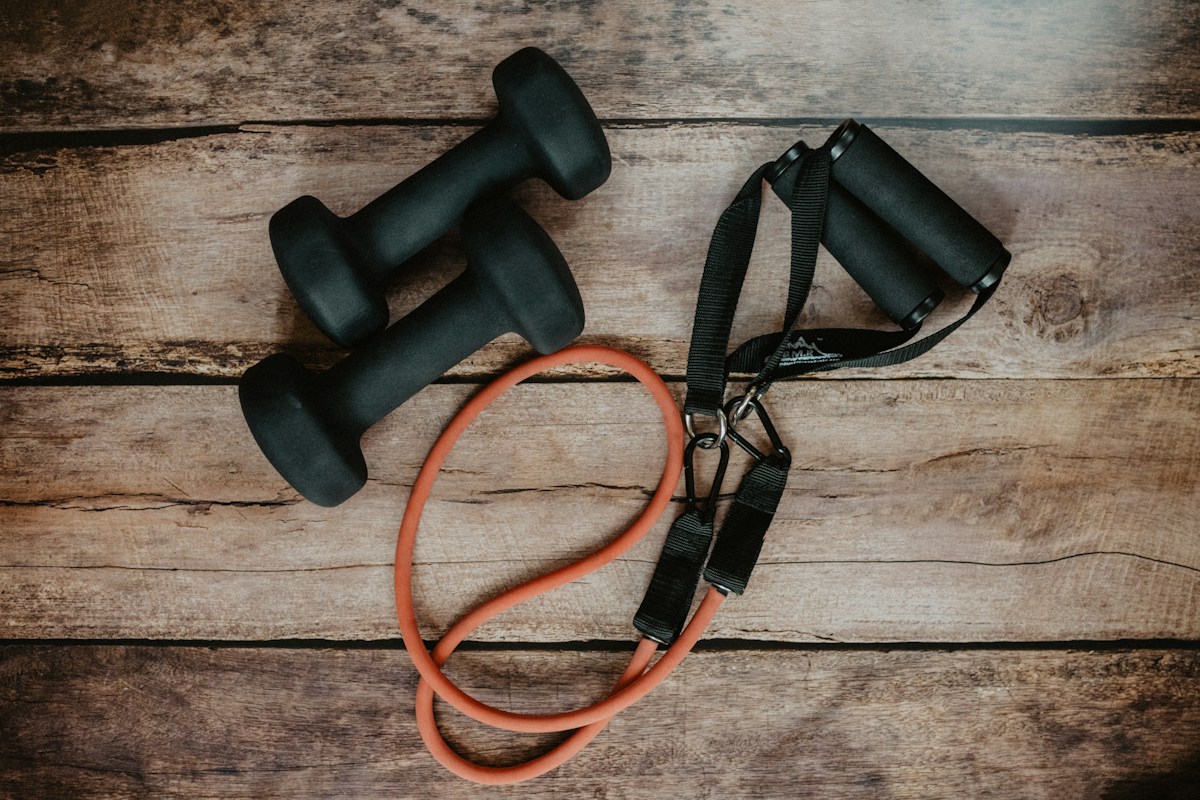
- A resistance band set. Light, cheap and easy to store. Loop bands and handled tubes both work for rows and presses.
- A pair of light dumbbells. Something in the 5 to 10 lb (about 2 to 4.5 kg) range covers most beginners; adjustable sets save space.
- A non-slip mat. For glute bridges and anything on the floor.
MUDDY FINDS: What you need
- Fit Simplify Resistance Loop Bands, set of 5 — Shop on Amazon
- Amazon Basics Neoprene Dumbbells, 5 lb pair — Shop on Amazon
- Gaiam Premium 6mm Yoga Mat — Shop on Amazon
Muddy Finds may include affiliate links. As an Amazon Associate, Muddy Stilettos earns from qualifying purchases, at no extra cost to you.
What you don’t need: anything promising to “tone,” “sculpt” or “melt.” That’s marketing, not muscle.
Making it stick (without a 30-day challenge)
The best strength routine is the one you’ll still be doing in March. A few small tricks help.
Anchor it to something you already do. Coffee’s brewing? That’s three minutes of sit-to-stands. Saturday morning walk? Do your carries in the driveway when you get back.
Put it in the calendar like an appointment. Two 20-minute slots. Same days each week if you can.
Pair it with walking. The Canadian guidelines pair strength with at least 150 minutes a week of moderate to vigorous aerobic activity, and a brisk walk is the friendliest way to get there.
Expect to feel a bit awkward. Learning a new physical skill after 40 is a bit like learning any new skill after 40: clumsy first, then quietly satisfying. We wrote about that in Learning Something New After 40 Is Harder. It’s Also Worth It.
Be kind on low-energy weeks. If you’re dragging, do one set instead of two, or swap a session for a gentle stretch. If tiredness is sticking around no matter what you do, that’s worth looking into; Why You’re Tired Even When You’re Doing Everything ‘Right’ walks through common causes.
Muddy tip
Two 20-minute sessions a week, six moves, one set to start. If you only remember one line from this article, make it that one.
Strength, hormones and the midlife picture
If you’re in perimenopause, you may be juggling a lot: changing sleep, energy that comes and goes, a brain that occasionally wanders off mid-sentence. Strength training isn’t a fix for any of that, and we’d never promise it is. But it’s one of the few habits public-health guidelines recommend for almost every adult, at every age, including yours.
For the bigger picture, read Perimenopause or Just Life? The Symptoms Women Keep Explaining Away, and if 3 a.m. has become your unofficial alarm, Why Are So Many Women Waking Up at 3 A.M.? is for you. Brain Fog in Your 40s: Perimenopause, Stress or Both? covers the foggy days.
FAQ
Is it too late to start strength training at 40, 50 or later?
No. The Canadian and US guidelines recommend muscle-strengthening activity for adults of all ages, including older adults, and the US guidelines note that people who are older or less fit can start with lighter activity and build up gradually.
How often should a woman over 40 lift weights?
At least twice a week, working all the major muscle groups. That’s the recommendation in both the CSEP 24-Hour Movement Guidelines (Canada) and the Physical Activity Guidelines for Americans.
Can I strength train at home with no equipment?
Yes. Sit-to-stands, wall push-ups, glute bridges and carries with household items all count. The US guidelines list body weight and elastic bands as forms of resistance. A band or light dumbbells simply make it easier to keep progressing.
Does strength training help bone health?
Public-health sources say it can support bone health. The US guidelines say muscle-strengthening activity increases bone strength, and NIAMS notes that resistance exercise puts healthy stress on bones. If you’ve been told you have low bone density or osteoporosis, talk to your health-care provider before starting, and ask about moves that suit you.
Will lifting weights make me bulky?
The beginner routine here (light weights, 8 to 12 reps, twice a week) is about strength and everyday capability. It’s not a bodybuilding plan, and how anyone’s body responds varies. Focus on what you can do, not on how you’ll look.
The Grounded One’s take
Somewhere along the way, a lot of us learned that exercise was a punishment for dessert or a project to make ourselves smaller.
Let’s retire that idea.
Strength training after 40 is the opposite of a punishment. It’s a quiet investment in the woman who wants to carry her own groceries at 80, lift her carry-on into the bin without asking, and get up off the floor after playing on it.
Start small. Two days. Six moves. One set. Notice what gets easier: the stairs, the laundry basket, the four-bag grocery run.
If you like tracking small wins, jot one line after each session in a journal. Ours, the Twice Daily journal, has just enough room for “did my six moves, felt strong.”
You’re not starting over. You’re starting strong.
Find more calm answers for complicated lives at The Muddy Wellness Desk.
ASK MUDDY
What’s stopping you from lifting: time, the gym, or not knowing where to start?
JOIN THE MUDDY COMMUNITY
Life gets messy. We talk about it. Join the free Muddy community at muddystilettos.ca for new stories every day, honest, researched and written for real women.
ABOUT THE MUDDY WELLNESS DESK
The Muddy Wellness Desk explores the health questions women are actually asking, from sleep and hormones to energy, stress, movement and the realities of feeling well in a busy life.
Featuring The Grounded One: calm answers for complicated lives. Research obsessed. Reads the studies so you don’t have to.
Muddy Wellness content is educational and informational and is not a substitute for individualized medical advice, diagnosis or treatment. Check with your health-care provider before starting a new exercise program, especially if you are pregnant or have a medical condition, an injury, or low bone density or osteoporosis. As an Amazon Associate, Muddy Stilettos earns from qualifying purchases, at no extra cost to you.
Sources
- Canadian 24-Hour Movement Guidelines for Adults 18-64, Canadian Society for Exercise Physiology
- Canadian 24-Hour Movement Guidelines for Adults 65+, Canadian Society for Exercise Physiology
- Physical Activity Guidelines for Americans, 2nd edition, U.S. Department of Health and Human Services
- Physical Activity Guidelines for Americans, 2nd edition: Executive Summary, U.S. Department of Health and Human Services / ODPHP
- Top 10 Things to Know About the Second Edition of the Physical Activity Guidelines for Americans, ODPHP
- Exercise for Your Bone Health, National Institute of Arthritis and Musculoskeletal and Skin Diseases
- Too Fit To Fracture, Osteoporosis Canada
- Pre-Screening for Physical Activity: Get Active Questionnaire, Canadian Society for Exercise Physiology
- PAR-Q+ and ePARmed-X+, PAR-Q+ Collaboration
0 Comments